Author's own text. The published version is at slideshare.net.
Who’s in charge?: Text, cognition, socialization and the freedom of spirit
Dominik Lukeš, 2010, to be submitted for publication
The central argument of this contribution is that the relationship between the text, cognition and the agency of the discourse participants is much more dynamic and multifaceted than is usually assumed by critical discourse analysts. The struggle over control between text, cognition and socialization can be seen played out both within the confines of the single textual interaction and in discourse spanning days, weeks or even years over vast expanses of text. But this text is not devoid of human agency, as is commonly assumed, but rather it provides evidence of a remarkable freedom of human spirit albeit within the constraints of the cognitive and social structures in which we embed our existence. However, I will argue, the mechanics of this grant property of humanity are much more prosaic and can be accounted for by adopting a collectively realistic theory of cognition and a cognitively realistic theory of text based on an essentially constructionist theory of grammar (e.g. Croft 2001; Goldberg 1995; Lakoff 1987).
Discourse Analysis and Cognitive Linguistics tend not to overlap in their areas of interest much to the detriment of both fields as was argued by the contributors to Hart and Lukeš (2007). Here I would like to focus on one of the points of unquestioned axiomatics that both these disciplines inadvertently share. I will argue that both could benefit from a critical examination of these axioms and furthermore establish closer contact as a result. The axioms I refer to are centered around the assumption that since all the underlying mechanics of cognition and text processing are unconscious, human beings are in thrall to their texts and where it leads them, they too must follow.
Previously (Lukeš 2007a), I have argued that we must question the sources of evidence presented for the “underlying” meanings of text, following Widdowson’s (2004) critique of Critical Discourse Analysis and proposing a text-based view of conceptual frames. Here I would like to take the same starting point but instead examine the role of the human agent in relation to text.
In general, I will maintain the centrality of Gadamer’s insight that “[t]he understanding and interpretation of texts is not merely a concern of science, but is obviously part of the total human experience of the world.” (Gadamer 1975:xi). An even more radical claim would be to say that the special nature of the “discourse analytic” enterprise lies more in the social than the cognitive realm, i.e. the analyst derives her prestige from the communal regard given to her endeavours rather than from possessing any exclusive mechanisms not available to any speakers of the language. Talmy’s developing work (Talmy 2007a; 2007b) on attentional phenomena in language and introspection has provided a classification of linguistic phenomena with regard to their availability which also includes important caveats that not all aspects of our use of language are equally easily available to us for conscious examination.
In a speech situation, a hearer may attend to the linguistic expression produced by a speaker, to the conceptual content represented by that expression, and to the context at hand. But not all of this material appears uniformly in the foreground of the hearer’s attention. Rather, various portions or aspects of the expression, content, and context have different degrees of salience. (Talmy 2007a:264)
It is an important constraints on the claims I make below that all the aspects of language that are potentially available to us are not available all at once and at all times to either the lay users of texts or the professional diviners of their inner workings. This paper’s central argument will play out on the fuzzy boundary between the general human text-processing ability and the specialist text-analytical distance.
There are two broad models of text with respect to human agency. One model, most crucially represented by the CDA, focuses on text as a reflection of our mind’s biases on the one hand and a repository of hidden messages triggering inevitably certain reactions. A non-CDA version of this position is taken up by Lakoff (2004) who illustrates our limited power over the mental images generated by text to the folk psychological narrative of a man asked not to think about a particular word while circling a cemetery. (A scenario found cross-culturally from children’s scary tales to science-fiction be it Buffy the Vampire Slayer or Ghost Busters.) Fauconnier and Turner describe the underlying principle on which this assumption rests when contrasting children’s and adults’ ability to process complex integrations:
We [adults] live directly in these blends [money, timepieces, writing]: We manipulate these elaborate networks with no conscious attention to the topologies and projections across the network. (Fauconnier & Turner 2002:389)
Within the critical discourse studies community this model was given voice at the very outset:
“The editorial is about actions, and the absence of actions. So we might expect the predominant model to be the transactive.”
“As readers of this editorial we should have to be alert and willing to engage in mental exercise to get beyond the seductive simplicity of the final form, with just three entities, and seemingly precise relations, where everything seems to be there on the surface.” ... “few commuters on the 8.05 from Brighton would have the energy to perform the mental gymnastics required. Especially as they would have to perform them not once, but just about a dozen times on every full line of newsprint that they scan. After all, the crossword is there for mental exercise.”
(Hodge and Kress, 1993 [1979], Language as Ideology, my emphasis)
Hodge and Kress here paint a picture of linguistic and cognitive inevitability from which an escape is possible only through the most strenuous effort. They do not provide any evidence other than their own feeling for this claim and indeed, they are not compelled to do so, because there is ample folk theoretical support for their view going back to Socratic criticism of Sophist rhetoric and persisting today in popular narratives of easily led and misled masses. In essence, to overcome the biases imputed by a purposefully or accidentally manipulative text is beyond mere human agency, it rather requires a “superhuman” agency such as that can be developed in a discourse analyst for the price of university tuition.
This was identified as questionable in some of the early reviews of “Language as Ideology” (Sharrock and Anderson 1981; also Stubbs 1997) but there is also a popular view of human independence of the ravages of text that can be placed at the heart of the alternative model of the interaction of text and human agency, namely one stating that people can see through text, know what it’s about and distinguish between it and reality. Perhaps, this is best expressed through the oft-quoted aphorism attributed to Lincoln: “You can fool all of the people some of the time, you can even fool some of the people some of the time but you cannot fool all the people all of the time.” This was put even more eloquently by the arguably biased comic book publisher William M. Gaines when testifying in front of the US Senate against restrictions on the publication of comic books:
“What are we afraid of? Are we afraid of our own children? Do we forget that they are citizens too and entitled to the essential freedom to read? Or do we think our children so evil, so vicious, so simple-minded that it takes but a comic magazine story of murder to set them to murder, of robbery to set them to robbery?”
(William M. Gaines, 1953, testimony to US Senate’s commission on comic books, http://www.onthemedia.org/transcripts/2008/04/25/06)
Similar points were made against a more recent version of the same controversy over video games by Gee (2003) and much of Widdowson’s critique of CDA rests on a similar discomfort with the extreme formulation of the first model.
Which of the two models is right? While I have not tried to hide my discomfort with the former position, there is evidence for both the model of textual determinism and textual freedom. Research in decision making has repeatedly shown strong priming effects from the formulation of a problem on the choices made regarding the solution of a problem (e.g. Kahneman and Tversky 1982; Holyoak and Thagard 1989; Holyoak and Kyunghee 1987) and this has even been used productively in education for instance with physics students who are more likely to choose correct solutions when they are presented with a specifically-framed problem (Gentner 1982). The ability to focus the listeners’ attention in one direction through words and gestures has been the stock in trade of magicians for millennia and the results of research in this area were recently used as a part of a road safety advertising campaign where viewers are asked to focus on one action on the screen (counting ball passes between one team of basketball players) causing them to miss a prominent feature (a person dressed as a bear strolling among the players performing a dance). But how far do these priming effects extend? In a series of studies of prejudice and the press, van Dijk, concluded that the media have exerted enormous powers over their readers through their use of text (defined very broadly):
“media as a whole define the internal structures, the points of relevance, and especially the ideological boundaries of social representations. They provide the ready-made models, that is, the facts and opinions, that people use partly in what to think, but more important which they also used in devising how to think about ethnic affairs.” (van Dijk, 1991: 244, my emphasis)
In a Matrix-like vision, van Dijk concludes by negating almost any real freedom from the readers of right-wing newspapers replacing it with an “illusion of freedom of opinion”.
“the manufacture of consent, also through the Dutch Press, is such that the people have the illusion of freedom of opinion, but they do not realize how strongly ideological constraints set the latitude of attitude formation and the terms of the public debate.” (van Dijk, 1991: 243, my emphasis)
But while I will offer an alternative interpretation of these “constraints” below, the evidence amassed by this wide-ranging research is compelling and in many cases beyond question. The consequences of this kind of priming can be far reaching as demonstrated by the famous Milgram (1974) experiment whose subjects were primed through textual and contextual framing to infer latitude for the commission of seemingly cruel acts.
However, there is equally strong evidence for the position exemplified by Gaines’ plea above. Predictable results do not always obtain over longer periods of time, violent comic books, video games or religious texts do not render whole societies irredeemably violent and neither do cuddly toys and messages of love and forgiveness make for cuddly, loving and forgiving collectives.
Research by Gamson and his colleagues (1992) has shown that while priming effects are present, working class people stripped of much of their agency by van Dijk evidence strong conceptual independence both individually and in groups.
“I do not deny the handicaps or argue that people are well served by the mass media in their efforts to make sense of the world. The limitations that media critics have pointed out are real and are reflected in the frames that people are able to construct on many issues. Frames that are present in social movement discourse but are invisible in mass media commentary rarely find their way into their conversations. Systematic omissions make certain ways of framing issues extremely unlikely. Yet people read media messages in complicated and sometimes unpredictable ways, and draw heavily on other resources as well in constructing meaning. “ (Gamson, 1992: 6, my emphasis)
Gamson’s point is that the effect of media manipulation or, to use van Dijk’s and Chomsky’s phrase, manufacture of consent is not simply in priming (in the same way that Lakoff’s reader is primed to think about an elephant by being asked not to think about an elephant) but rather in the limited availability of information, topics of conversation and vocabulary to discuss the topics of information.
Even van Dijk seems to accept a certain level of independence of his subjects on the text, albeit, independence in the wrong direction:
“right-wing readers of a right-wing newspaper have an ideological framework that facilitates the development of right-wing opinions whatever the opinion of their newspaper.” (van Dijk, 1991: 238, my emphasis)
How is it possible that readers of a right-wing rag maintain their racist position even when their rag occasionally adopts a non-racist stance? It is also important to remember that all of van Dijk’s subjects had in their youth undergone a serious and concerted effort by the educational system to manipulate their opinion in the direction that van Dijk and I prefer. How could have the sophisticated and carefully selected texts of the educational and mainstream establishment failed so miserably in their transmission (both covert and overt) of the values that van Dijk, Lakoff and I share? A weak educational system operating on weak minds is the common answer in many circles but isn’t just as likely the explanation that the right-wing racists whom we fear and despise have actually shown a remarkable independence of spirit that demands an explanation? Gamson’s research shows the complicated and sophisticated nature of working-class discourse. Even Lakoff in his earlier work (Lakoff 1996) gives hints of why the same evidence produces different conceptualizations that are both internally consistent and moral although when brought into contact they must claim mutual moral exclusivity. Lakoff’s detailed analysis of certain segments of the conceptual inventory behind American political discourse ignores one crucial aspect, however; namely the internal nature of that inventory and the processes that lead to its composition and constant reshaping.
In the remainder of this paper, I will focus on some key aspects of this inventory and give examples of how its dynamic nature shaped one particular type of discourse. I will argue that we can only understand the discourse processes in their entirety if we embrace both models of text and human agency as valid and focus our attention on their interplay rather than try to establish the primacy of one over the other. It is beyond question that the kind of unconscious processes identified by Lakoff (1987) and others are indispensable to our cognition and language but as Edwards (1991) points out in the title of his paper: “categories are for talking”. He and his fellow discursive psychologists accept the findings of their cognitive counterparts but claim that “the cognitive approach fails to explicate how actual categorizations, things that are said, function as actions fitted for their occasions.” A purely cognitive approach can only see things that it is prepared to see by its methodological tools. Sadly, discursive psychology goes on to happily don its own blinkers in their embrace of conversation analysis as the all abiding method to the analysis of discourse and thus is not able to see most of the phenomena I deal with here.
The struggle between the unconscious (agentless) and the conscious (agentive) in our understanding of text can be illustrated by the phrase “life-long native” recently discussed by the Figurative Language Network mailing list. Not found in corpora such as the BNC and COCA, a search on Google for “life-long native of *” yields thousands of results. People are commonly both described and describe themselves as “life-long natives”, on company biographies, in newspaper profiles or obituaries, resumes, website profiles, forum postings, etc. There seem to be no limits on what kind of a place people can be life-long natives of: towns, cities, counties, states. Life-long nativeness seems to start in the early twenties and continue after death. On encountering this phrase in context, most speakers are likely to process it without pause. But on closer reflection we also know that this phrase makes no sense at all. All “natives” are life-long by definition. Assuming that “a native” is someone born in a certain place, no matter what happens to that person later on in life the fact that they were born somewhere does not change. A commenter on a mailing list offered this claim: “the utterer who defeasibly utters a tautology or redundancy (‘lifelong native’) also utterly and defeasibly commits hisself to the alleged counterpart contradiction (a ‘late-arriving native’) that makes the original phrase meaningful in the first place!” How are both the uncomplicated and straightforward understanding and a contentious meta-linguistic understanding possible? Neither of the two seems to require any special processing powers or a particular linguistic skill although the details of this claim are subject to empirical testing. Quite obviously, the concept of a “native” is complex and subject to the whole range of cognitive processes described for instance by Lakoff (1987). First, “native” carries with it a number of “schematic” narratives, scripts or scenarios. We already saw the “birth” schema. However, there are also the two opposite “after-birth” scenarios in which the person either stays in the place where they were born or they move away. Both of these scenarios offer quite a wide degree of variation. It is possible to be born in a hospital in a bigger town and still be considered a native of the place where the parents resided at the time. Also, there is a significant difference between somebody who moved away as a child without a conscious effort and someone who left of their own free will in early or late adulthood. We also have a number of schematic narratives to explain the reasons for moving: marriage, better job or escape. Describing somebody as a life-long native, is to contrast their scenario of being native to somewhere with all the other possible ways of being native. And because many of the above scenarios contain negative evaluations of varying strength, being a life-long native implies a positive evaluation. However, as indicated above, the word “native” also contains a propositional element with a syllogistic schema and a folk-theoretical understanding of word meaning. I.e. a person is a “native of X” by virtue of being born there and since the place of birth is a fact that cannot be changed by later events, the modifier “life-long” adds no elaborative meaning to the word “native”. All normally competent speakers of a language have access to both of these conceptions of “native” and quite likely a person using the term “life-long native” would admit to the syllogistic shortcomings if they were pointed out to them. However, even though we should be able to convince most utterers of the phrase of the “error” of their ways, we cannot deny the meaningfulness of the “life-long native”. Like its counterpart “cheaper price” (complex in its own way), it plays an indispensable role in our meaning making.
The process that makes it possible for us to understand this expression and make perfect sense of it, is what I call “framing” (following Gofmann and many others but synonymous with a host of competing terms with similar content, see Lukeš 2007) while the process that makes it possible for us to understand and discuss the fact that it makes no sense at all, I refer to as “frame negotiation”. The ineluctable presence of both of these processes in all discourse can make it possible to reconcile the two models of text-cognition causality exemplified by the quotes from Gaines and Hodge and Kress above and the contrast between the position of Lakoff and van Dijk on the one hand and Gamson on the other. Frame negotiation obviously depends on our ability and disposition to bring up formal and procedural properties of our language to conscious exploration. Ability that Hodge and Kress seem deny to the common commuter but one that Gadamer and Talmy believe exists on a continuum from that which is prerequisite to our linguistic existence through the theory-laden to that which is machine assisted (the machines ranging from palatograms to the tools for corpus analysis). Indeed, this ability is already encoded in our language through hypostasis (see e.g. Bloomfield 1984 [1933]) in expressions like “I’m not interested in your ifs and buts” or “we’re a can do people”. This ability and its daily performance is seen as either superfluous or undesirable (e.g. Krashen 1981) or just something that just happens and needs no explanation. Widdowson sees it as confined to just one level of processing:
“linguistic analysis of text is not necessary for understanding. Indeed, it would appear that, if anything, it deflects attention from an inference of meaning and interferes with interpretation, so that the first level of analysis in Halliday’s scheme has a way of obstructing the processing at the second level.” (Widdowson, 2004)
But these levels if they exist at all are highly permeable and I would argue that one is indispensable for the other. Let’s consider two simple examples. First, here’s a common interaction from the “bully scenario” acted out in countless real situations from playgrounds to drinking establishments:
Bully: Who are you looking at?
Victim: Nobody.
Bully: Are you calling me nobody?
In this case, both the bully and her victim know that they are playing out a script that contains no escape for the bullied. The bully does not for a moment assume that the victim is calling her “nobody”, she knows the common usage and also knows the victim’s intended meaning and sees it for the strategy of conflict avoidance that it is. But she is also aware of the paradigmatic constructional properties of her question inferred from exchanges like “Who bought the cake?” “Carol.” and exploits those to pretend that this interpretation of the interchange is a plausible one. The victim is also fully aware of the dangers but has no alternative routes of escape other than paralinguistic signs of submission. But it is not only the awareness of language that is at play here, it is also a complete acknowledgement of the genre of the bully/victim exchange and its sociolinguistic context. Both participants know what is going on and see their interaction for what it is, an instantiation of a type. We can see its reflection even outside the context of physical bulling. Here are two examples from online forum discussions:
Comment from... Shirin, at January 30, 2009 04:10 PM:
“Nobody’s asking the US to turn its back on Israel.”
Are you calling me nobody?http://justworldnews.org/archives/003363.html (accessed July 2009)
by apronymaniac » Sat Mar 25, 2006 9:52 am
*PixieWolfe wrote:But nobody noticed. Oh, well...* I noticed. Are you calling me nobody? ☺http://spamusement.com/forums/viewtopic.php?t=1793 (accessed July 2009)
Obviously, as the smiley face in the second example indicates, the writers are aware both of the implications and the inappropriateness of their usage and expect the same level of awareness in their readers in order to achieve their referential effect.
Presumably there must have been the first bully who ever landed on this stratagem by mistake and there are languages and cultures whose inventory of exchanges does not contain this particular schema but in order for language to function, a capability for an exchange like this must exist. And it must go further than that. Reflections on usage are common in folk definitions which in turn abound in all cultures (see for instance the popularity of http://www.urbandictionary.com). Let us consider this definition explaining a statement commonly attributed by men to women:
“‘If you don’t know, I’m not going to tell you.’
A manipulative ploy commonly used by young females to confuse and/or further frustrate the person (usually a male) to whom this statement was uttered. “
http://www.everything2.com/index.pl?node_id=549778 (accessed June 2008)
Again, what we see here is not merely the awareness in the moment of usage of the implications of the statement but also the ability to place the statement in a genre and refer to a broader social convention. Of course, we also see the writer effortlessly is not particularly skillfully switching to the register mimicking that of formal encyclopedic definitions.
In both of these examples we have the constant interplay between usage and meta-usage not as separate levels but rather intertwined strands of language and cognition. Keeping in mind that while any aspect of usage can be brought up for introspection and hypostasis, not all of them can be treated in this way at once, just like in formal linguistic analysis.
But sometimes we reach for a construction and it simply isn’t there to be had. Here I’d like to tell the story of permission slips. Some years ago, my friend in her first year as a teacher, showed me a sheaf of permissions slips that her pupils brought home regarding their upcoming field trip. Under our critical gaze, they ranged from the ridiculous to the more ridiculous. Below are a few examples loosely translated from Czech based on my personal recollection (sadly, I did not think to save them at the time):
She can go.
Billy can go on the trip.
It’s ok.
SmithI hereby certify that my son, Jeremy, has my permission to attend a school trip.
Dr. S Jones.
It is obvious that each parent found themselves in an awkward situation where they had to call up a scenario of a conversational exchange and perform their part in it using a different modality. The teacher simply told the child to ask their parents for a written permission. But while this calls up the conversational scenario in which a simple “yes” or “it’s ok” would suffice, there are many aspects of the conversational scenario that are missing. For instance, the identity of the interlocutor may not be obvious which is why one parent chose to sign a name under a simple affirmative. Others felt the need to fill in some of the referents that would be anaphorically accessible in normal conversation and yet others felt it necessary to switch register to a folk legalistic mode. When we were done laughing, my friend and I set about the task of composing a permission slip that would pass the muster of our irreverence. And we discovered that it simply cannot be done. Our language (it was Czech in our case but the same applies probably to any language) simply does not contain a register of expressions capable of handling this situation. Except, of course, it does in the paralinguistic realm. It is possible, and relatively easy to facilitate this asymmetric conversation by a simple use of a pre-set form where all that is required of the interlocutor is a signature and possibly some supplementary information. And again, the use of these forms is not unconscious without reference to the communicative medium. These forms are carefully designed, thought about and above all shared. See Figure 1. A cursory search on Google will reveal not only a cornucopia of templates and samples of field trip permission slips but also the fact that “field trip permission slip samples” is one of the common searches related to field trips and appears in the suggested searches list (unfortunately, it is not common enough to register on the Google trends service).
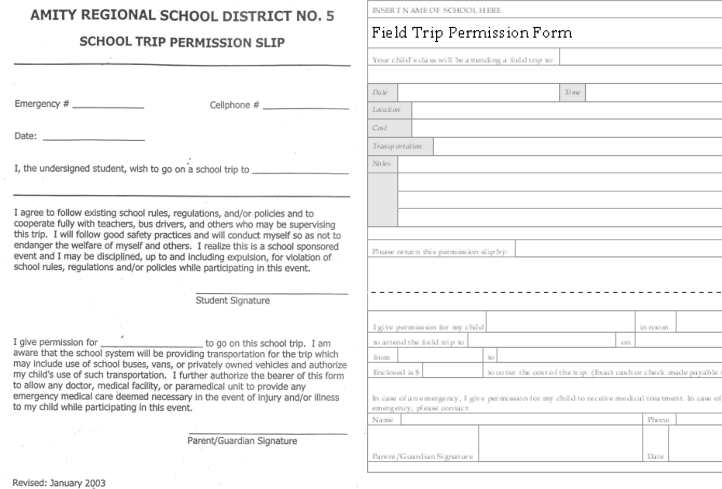
Figure 1
These examples are not isolated special events but rather are a part of the common experience of all speakers of a language (although just how much and how uniformly across different speakers is an area for further research). Therefore, they need to be integrated into mainstream linguistic theory, something Discursive Psychology and Conversation Analysis in general have failed to do. I will suggest that this is best done by adopting and expanding two key concepts from cognitive and construction grammar, namely that of construction and inventory. Taylor (2002) summarizes cognitive grammar as seeing language as an “inventory of symbolic units”, the symbolic units being pairings of form and meaning (in the sense of Langacker 1986). I propose (see Lukeš 2007 for more detail) that we can look at discourse-level phenomena as a type of constructions for which the notion of the inventory then becomes crucial. Cognitive and construction grammars provide some properties for the inventory (see most notably Croft 2001), but much of the crucial detail is missing and I am certainly aware of no attempt at providing even a sketch of a portion of a complete inventory. While I do not propose to outline such a sketch here, I will suggest a few properties we should expect to see in the inventory if we want to live up to Fillmore et al.’s (1988) original agenda for construction grammar.
Another key aspect of language units as envisioned by cognitive grammar is the nature of their mental representation. Knowledge of linguistic units is the same kind of knowledge as other kinds of knowledge (encyclopedic, episodic, etc.) and exhibits the same kinds of organizational, cognitive and social properties (incl. basic-level hierarchies, prototype category effects, underspecification, redundancy, conventionalization, culture/language-specificity, explication, negotiation) as knowledge studied by the more established strands of epistemology. Cognitive linguistics is at core radically anti-modular and I suggest (following a path parallel to that of Discursive Psychology) that its antimodularity needs to be expanded still further.
Constructions as foundational units of linguistic description have many other advantages most notably the fact that we have a viable hypothesis for their online processing namely conceptual integration. It is beyond the scope of this chapter but the act of frame negotiation offers an important expansion to conceptual integration that can help it account for a wider array of discursive phenomena.
Additionally, I will claim these properties as crucial for constructions as linguistic units:
-
Semantic pole of the unit is structured by (largely negotiated) frames (cognitive models, etc.)
-
Formal pole is structured by convention and language logistics
-
Blending occurs on both the formal and semantic poles
-
Units can be both rich (vocabulary, idioms, topoi) and schematic (rules, organizational principles, register, …)
-
Units can be as ‘large’ as genre and as ‘small’ as phonological features
-
Many units are available to introspection and therefore to negotiation (both implicit and explicit)
I only have space to illustrate some of these claims here (see Lukeš, in preparation for more details).
Let us now turn to a final example of the interplay between discourse as an agent outside our control and discourse that serves human purposes. This is a brief extract from a speech made by Barack Obama on race relations on 18 March 2008 in the wake of public debate over his relationship with a controversial preacher, Reverend Right.
“And this helps explain, perhaps, my relationship with Reverend Wright. As imperfect as he may be, he has been like family to me. He strengthened my faith, officiated my wedding, and baptized my children. Not once in my conversations with him have I heard him talk about any ethnic group in derogatory terms, or treat whites with whom he interacted with anything but courtesy and respect. He contains within him the contradictions - the good and the bad - of the community that he has served diligently for so many years.
I can no more disown him than I can disown the black community. I can no more disown him than I can my white grandmother - a woman who helped raise me, a woman who sacrificed again and again for me, a woman who loves me as much as she loves anything in this world, but a woman who once confessed her fear of black men who passed by her on the street, and who on more than one occasion has uttered racial or ethnic stereotypes that made me cringe.”
(http://www.npr.org/templates/story/story.php?storyId=88478467, accessed June 2008, my emphasis)
What we see Obama do is a step by step development of a conceptual domain in the first paragraph which then allows for an analogical statement at the beginning of the second paragraph emphasized in bold. This is a common rhetorical device but note that it externalizes the processes described as unconscious by Lakoff and Johnson in their theory of metaphor and Fauconnier and Turner in their theory of conceptual integration or blending. While it is true that no special overt effort is necessarily required for either the production or understanding of the blend, its mappings are out in the open. The passage in bold would certainly make sense even without the preceding description but both the formal and conceptual predispositions of the rhetorical argument genre prefer that it be there. Nevertheless, despite the explicitness, the mappings between the domains of family and community, Wright and grandmother are partial and underspecified. The space allows for more possible mappings but the text reduces the options for immediate blending. This would be a fairly traditional blend analysis if we stopped here. But if we did that we wouldn’t have the complete picture of what goes on in text. As Hoey (1991) pointed out we have a tendency to see text as just a bigger sentence. Instead, he offers an alternative metaphor of text as an oeuvre with multiple links and connections going in all directions (similar to but more fundamental than Fairclough’s intertextuality). Let us look at Obama’s speech in a similar light. Its delivery elicited a wide range of reactions that continued the elaborations of the conceptual spaces he started building there. These reactions included reference to the form, meaning and hidden meaning in a much more complex fashion than public debate is generally given credit for (see van Dijk quoted above).
I thought Barack Obama’s speech was strong, thoughtful and important. Rather beautifully, it was a speech to think to, not clap to. It was clear that’s what he wanted, and this is rare.
It seemed to me as honest a speech as one in his position could give within the limits imposed by politics. As such it was a contribution. We’ll see if it was a success. The blowhard guild, proud member since 2000, praised it, and, in the biggest compliment, cable news shows came out of the speech not with jokes or jaded insiderism, but with thought. They started talking, pundits left and right, black and white, about what they’d experienced of race in America. It was kind of wonderful. I thought, Go, America, go, go.
(Peggy Noonan, Declarations - WSJ.com http://online.wsj.com/article/SB120604775960652829.html, accessed June 2008, my emphasis)
The highlighted passages in this extract gradually develop the notion of performance as being central to appreciating the content. The author manages to combine evaluations of impact on listeners, content and social significance in a simple phrase “strong, thoughtful and important” but also recognizes the speaker’s position and the limitations on what can be said: “limits imposed by politics” and the predictability of other reactions: “jaded insiderism”. A similar effect is achieved by a commenter in a rival publication.
Barack Obama’s speech on race in America was so candid about both the legitimacy of black and white grievances -- and the flaws in those grievances -- it carried the risk of offending almost everyone.
(E. J. Dionne Jr. - Another Angry Black Preacher - washingtonpost.com http://www.washingtonpost.com/wp-dyn/content/article/2008/03/20/AR2008032003021.html, accessed June 2008, my emphasis)
We might be swayed by these comments (from opposite sides of the political spectrum) and many more like these, as well as the power of the speech itself into assuming that the text simply leaves no room for rival interpretation. In fact, the text left room for significant debate. Let us consider this title of a blog post:
Barack Throws His Ailing Grandmother Under the Bus to Score Political Points
This is significant for two reasons. First, it reflects on the power of the text in the discussion space. The reason the readers could understand as a hyperbole rather than a literal description of an incident is on one hand the background knowledge of the world (Obama has a grandmother worth talking about, people like Obama don’t push grandmothers under buses) but also the knowledge of the text. This will vary across various readers but a significant number of them who have heard, read or heard of the speech will instantly understand which passage this title responds to and why. The second reason why this passage is noteworthy is that it consciously builds new reference points in the conceptual space built by the original speech. Whereas Obama’s text was structured to integrate frames of a white woman raising a black grandson (a positive evaluation) and a white woman making racist remarks (a negative evaluation) in a way to suggest an excusable flaw in a good person, this text suggests a possible alternative blend: that of slander of a good person. Both of them see racist remarks as bad but one of them suggests that other actions can explain and excuse them whereas the other sees them as too significant to be uttered about anybody no matter whether the intention of the speaker is to maintain the positive evaluation. This dissent does not stem from a misunderstanding of Obama’s intent nor from an inevitably different perspective but rather from a conscious explorations of the underpinnings of the original framing and a purposeful reframing through a reintegration of the composite frames.
We can see the same process in more detail in this passage from a different blog that uses an imaginary narrative to explain the position:
Your grandfather and I just figured we should treat people decently, Bar. That’s all.” It seems that she succeeded in raising a color blind daughter but not a color blind grandson. Obama said his grandmother, Madelyn Dunham, is “glued to CNN”‘ and follows the campaign closely, even though severe osteoporosis prevents her campaigning. I can only imagine how defeated his dismissal of her as a “typical white person” must make her feel. She may be grateful, her husband is no longer alive and forced to see himself dismissed as a typical white racist.
(History News Network, http://hnn.us/blogs/entries/48659.html, accessed June 2008, my emphasis)
Once discovered the “Obama slanders grandmother” construction is available for later reuse when Obama tells stories about his grandmother:
Obama trashing his grandmother again? (http://michellemalkin.com/2008/03/20/obama-trashing-his-grandmother-again, accessed June 2008)
So we see that both positive and negative evaluations have an effect of contributing to an inventory of frames (strong, important, brave speech or slander of grandparent) that can then be reused, elaborated and challenged in various ways. This inventory can be drawn upon almost immediately where the communication networks permit the speed or with greater distance such as in a book about the speech published almost a year later (Sharpley-Whiting 2009).
The legitimacy of either of these framings can be challenged by reference to political bias as a last bulwark of the subconscious power of text. But this elaborate text of the speech debate contains many opportunities for a discussion of just such a bias interwoven into analysis of the content. We saw above an example of an evaluation of the effects of the speakers position but there are as many assessments of the positions of the readers. This one refers to the importance of reading the text fully and noting its potential for convincing a reader otherwise predisposed to disagree with the author:
Have I missed the competition? [Charles Murray]
I read the various posts here on “The Corner,” mostly pretty ho-hum or critical about Obama’s speech. Then I figured I’d better read the text (I tried to find a video of it, but couldn’t). I’ve just finished. Has any other major American politician ever made a speech on race that comes even close to this one? As far as I’m concerned, it is just plain flat out brilliant—rhetorically, but also in capturing a lot of nuance about race in America. It is so far above the standard we’re used to from our pols.... But you know me. Starry-eyed Obama groupie.
(http://corner.nationalreview.com/post/?q=MjI3MWMyOGFkNmQ2MGFjNzRhYzYwMGVhZWJhMjcyOGM=, accessed June 2008, my emphasis)
The irony of the concluding phrase resonates against an elaborate frame built around a partially filled schema of an unlikely agreement based on a surprising statement from an opponent despite the fact that this agreement may brand the agreer as belonging to an out-group from the perspective of her peers. This is a common rhetorical strategy but its commonality suggests even more strongly the ubiquity of frame negotiation and public awareness of its results and implications.
What is important about this extended text for the present discussion is that almost every possible analytic statement available to the discourse analyst was made by the participants in the debate at one point or another! Far from being simply an unconscious collection of frames and pragmatics, it presented a whole range of analytic opinion drawing on both instant blendings and careful reframings with challenges to both. It lends support to Gadamer’s axiom cited above. This is not to suggest that the unconscious processes of our cognition upon which many of the advances of cognitive linguistics were built are not present or not important. They are what makes this entire text possible in the first place. But they can be and are frequently hypostasized, examined and renegotiated leaving us, if not quite in charge of our texts, in a process of a collective struggle for control.
In some respects, this realization opens more questions than it answers. What are the linguistic units upon which this tapestry of textual interconnections is built? What is the nature of the inventory upon which speakers can draw to make their expressive choices? How are this inventory and its units acquired (unconsciously) and learned (consciously)? How is this inventory created and how is it maintained?
For instance, it could be argued that many of the authors of the examples above are language professionals (Peggy Noonan’s bio, for instance, identifies her as a speech writer prior to becoming a columnist) but many others are not and even those not engaging in written online discussions are capable of such exchanges (as shown by Gamson cite above). Even if not all discourse participants engage in a uniform level of introspection, it is a ubiquitous and I argue essential property of discourse.
My suggested answer is that the linguistic units comprising the available inventory are constructions where the form ranges from words/phrases to cohesive harmony and meaning is structured by frames. The inventory of such constructions is then negotiated through repetition, referencing and explicit debate including that drawing upon the analysis of form, meaning and supposed hidden meaning.
The following is only a brief sketch of what these constructions might look like. I draw on Lakoff’s (1987) description of Idealized Cognitive Models for the description of the semantic pole of the construction pairing it with the repetitions observed in a small corpus of texts reacting to the speech illustrated above. Obviously, regularities at this level of discourse are much more difficult to study given that the concordancing utility of corpora is significantly reduced for the study of units larger than the phrase.
Construction 1: “Speech assessment”
-
Form
-
Topoi: Statements about media, Descriptions of personal reactions
-
Discourse orientations: Historical context, present context, other reactions, personal discourse history
-
Set phrases: “predictable”, “political points”, “in our X time”
-
-
Meaning
-
Propositional: Media shallowness frame, Criticism of opportunism, Speech content evaluation (positive), etc.
-
Figurative: Obama = Kennedy, Obama = Martin Luther King, positive feelings = uplifting, etc.
-
(Image-)Schematic: relationship between speech and recipients, relationships between critics and their background, etc.
-
Construction 2: “Obama’s Racism”
-
Form
-
Topoi: Statements about media, Statements about liberals
-
Discourse orientations: Quotation, rephrasing, ‘X really means Y’
-
Set phrases: ‘trash grandma’, ‘throw grandmother under the bus’, ‘political points’ …
-
-
Meaning
-
Propositional: Obama’s grandmother raised him and he’s calling her a racist
-
Figurative: grandmother = Jeremiah Wright, Obama = Jeremiah Wright
-
(Image-)Schematic: grandparent-grandchild relationship, alienation story, opportunism story
-
The description above is not an exhaustive description of each construction nor do I necessarily assume the same mental status for them as we assume of constructions like “X tells Y to Z”. However, a survey of the text surrounding the debate suggests that the debate participants draw on a finite set of constructions very much like these. In use, the constructions are mobilized from an inventory which arises as the debate goes on as a modification of other existing inventories. To make sense or to be made sense of, the constructions are integrated (blended) in both form and meaning with other appropriate constructions at multiple levels. The inventory provides the limiting framework for the debate but the openness of the process of blending provides the freedom and variety.
In conclusion, speakers wishing to express a particular position have available to them units (constructions) carrying both form and meaning. In particular ‘discourse communities’ (coalitions), the availability of the inventory and possible blendings can be constrained through both explicit and implicit negotiation. As a result, these constraints are social and textual as much as cognitive. How exactly each individual speaker retunes the blending parameters of their inventory is something open to further investigation. We should expect to find a variety of processes and strategies rather than a unitary principle. What seems to be clear, however, is that the unconscious process of blending cannot be sufficient to describe the actual ebbs and flows of extended discourse. We will miss important phenomena if we only treat the text as being in charge. We need to return human agency to text and cognition and to take to heart Gadamer’s suggestion about the nature of our discourse analytical tools. Insights about how meaning comes about are not confined to the specialist. They are just as likely to come from passengers on the 8.05 from Brighton and therefore they are themselves a part of what makes meaning and its creation possible. The process is complex and needs to be sought across vast stretches of discourse rather than in dramatic excerpts. At least in part, it is quite likely to be not unlike the way one of Tom Clancy’s characters describes high-level political negotiations:
“Everybody thinks it’s dramatic, but it’s not. I’ve never seen anything more boring. Both sides say exactly the same thing for hours – they repeat themselves about every fifteen or twenty minutes, all day, every day. Then after a week or so, one side or the other makes a small change, and keeps repeating that for hours. The other side checks with its capital, and makes a small change of its own, and keeps repeating that.”
(Tom Clancy, Cardinal of the Kremlin)
References
Bloomfield, Leonard. 1984. Language. Chicago: University of Chicago Press.
Croft, William. 2001. Radical construction grammar: Syntactic theory in typological perspective. Oxford: Oxford University Press.
van Dijk, Teun A. 1991. Racism and the press. London; New York: Routledge.
Edwards, Derek. 1991. Categories Are for Talking: On the Cognitive and Discursive Bases of Categorization. Theory & Psychology 1(4). 515-542. doi:10.1177/0959354391014007.
Fairclough, Norman. 1995. Critical discourse analysis: the critical study of language. London: Longman.
Fauconnier, Gilles & Mark Turner. 2002. The way we think: conceptual blending and the mind's hidden complexities. New York: Basic Books.
Fillmore, Charles J., Paul Kay & Mary Catherine O'Connor. 1988. Regularity and Idiomaticity in Grammatical Constructions: The Case of Let Alone. Language 64(3). 501-538.
Gadamer, Hans Georg. 1975. Truth and method. London: Sheed and Ward.
Gamson, William A. 1992. Talking politics. Cambridge; New York: Cambridge University Press.
Gee, James Paul. 2003. What video games have to teach us about learning and literacy. New York; Basingstoke: Palgrave Macmillan.
Gentner, Dedre. 1982. Are scientific analogies metaphors? In David S. Miall (ed.), Metaphor: Problems and perspectives, 106-132. Brighton: Harvester.
Goldberg, Adele E. 1995. Constructions: A construction grammar approach to argument structure. (Cognitive Theory of Language and Culture). Chicago: University of Chicago Press.
Hart, Christopher & Dominik Lukeš. 2007. Cognitive Linguistics in Critical Discourse Studies: Application and Theory. Newcastle: Cambridge Scholars Publishing. http://www.amazon.co.uk/Cognitive-Linguistics-Critical-Discourse-Analysis/dp/1847182275.
Hodge, Robert & Gunther Kress. 1993. Language as ideology, 2nd ed. Vol. 2. London; New York: Routledge.
Hoey, Michael. 1991. Patterns of lexis in text. Oxford: Oxford University Press.
Holyoak, Keith J. & Koh Kyunghee. 1987. Surface and structural similarity in analogical transfer. Memory & Cognition 15(4). 332-340.
Holyoak, Keith J. & Paul Thagard. 1989. Analogical mapping by constraint satisfaction. Cognitive Science 13(3). 295-355. doi:10.1016/0364-0213(89)90016-5.
Kahneman, D. & A. Tversky. 1982. Variants of uncertainty. Cognition 11(2). 143–157.
Krashen, Stephen. 1981. Second language acquisition and second language learning. 1st ed. Oxford New York: Pergamon Press.
Lakoff, George. 1987. Women, fire, and dangerous things: What categories reveal about the mind. Chicago: University of Chicago Press.
Lakoff, George. 1996. Moral politics: what conservatives know that liberals don't. Chicago: University of Chicago Press.
Lakoff, George. 2004. Don't think of an elephant!: Know your values and frame the debate: the essential guide for progressives. White River Junction, Vt.: Chelsea Green.
Langacker, Ronald W. 1986. An Introduction to Cognitive Grammar. Cognitive Science 10(1). 1-40.
Lukeš, Dominik. 2007a. What does it mean when texts ‘really’ mean something?: Types of evidence for conceptual patterns in discourse. In , Cognitive Linguistics in Critical Discourse Studies: Application and Theory. Newcastle: Cambridge Scholars Publishing.
Lukeš, Dominik. 2007. What does it mean when texts ‘really’ mean something?: Types of evidence for conceptual patterns in discourse. In Cognitive Linguistics in Critical Discourse Studies: Application and Theory. Newcastle: Cambridge Scholars Publishing.
Milgram, Stanley. 1974. The Dilemma of Obedience. The Phi Delta Kappan 55(9). 603-606.
Sharpley-Whiting, T. 2009. The speech : race and Barack Obama's "A more perfect union". 1st ed. New York: Bloomsbury.
Sharrock, W. W. & Digby C. Anderson. 1981. Language, thought and reality, again. Sociology 15(2). 287-293.
Stubbs, Michael. 1997. Whorf's children: Critical comments on Critical Discourse Analysis. In Evolving models of language, 100-116. Clevendon: Multilingual Matters.
Talmy, Leonard. 2007a. Attention Phenomena in Language. In Dirk Geeraerts & Hubert Cuyckens (eds.), Handbook of Cognitive Linguistics. Oxford University Press. Oxford.
Talmy, Leonard. 2007b. Introspection as a Methodology in Linguistics. In Plenary lecture at the 10th International Cognitive Linguistics Conference. Krakow, Poland.
Taylor, John R. 2002. Cognitive grammar. Oxford: Oxford University Press.
Widdowson, H. G. 2004. Text, context, pretext: critical issues in discourse analysis. Malden, MA; Oxford: Blackwell.
Wodak, Ruth. 2001. What CDA is about - a summary of its history, important concepts and its developments. In , Methods of Critical Discourse Analysis, 1-13. London; Thousand Oaks; New Delhi: SAGE.