Author's accepted manuscript. The published version is not online.
Dominik Lukeš
Research, Development and Policy,
Dyslexia Action, United Kingdom
Chris Litsas
National Technical University of Athens,
Greece
Abstract— This paper describes the results of work done to develop an automated guidance system for readers with dyslexia and related literacy difficulties. The system was developed to address the specific needs of dyslexic readers and teachers providing support to them in the analysis of words into their phonic components. This includes division into syllables both in spoken and written form, mapping of graphemes to phonemes and highlighting of common spelling patterns. Despite a large volume of NLP resources being available, we could identify no system that would provide this level of analysis. Such system is necessary to advance the field of computer-assisted literacy support. For instance, by developing open-world games not limited to pre-set lists of words or a reader application that can highlight phonic features of any word. In order to provide such guidance we designed an annotated dictionary, list of phonic features with associated look up routines and dictionary annotation algorithms. The resulting phonics engine was then used to power a reader application and a phonic games system developed as part of iLearnRW. We make recommendations for further directions in research and development.
The research and development described in this paper was conducted as part of the EU FP7 ICT project iLearnRW - Integrated Intelligent Learning Environment for Reading and Writing (318803).
Keywords—natural language processing, computer-aided instruction, phonics, mobile technology, dyslexia, readability
Introductory note
The iLearnRW project which sponsored the work reported in this paper developed all tools for two languages English and Greek. However, the vast majority of the work done was on English due to its peculiar level of complexity in the area of phonics and orthography. Therefore, unless specified, the issues discussed pertain to English. Greek is mentioned only as relevant.
Introduction
Literacy interventions that are offered to readers with dyslexia and related linguistic or cognitive impairments require highly specialised knowledge of English phonics on the part of the teacher. Thus parents, community volunteers or even teaching assistants employed by schools may not be relied on to provide the appropriate structured guidance to the struggling reader (child or adult). Furthermore, due to the complexities of English phonology and orthography, even specialist teachers are not always able to apply the principles to any given word that may present itself in the course of reading. Yet, there is no automated tool to make this easier for literacy professionals. Established tools such as pronunciation dictionaries or online corpora are of limited utility because they do not combine sufficient orthographic information. Even machine readable data sets developed for Natural Language Processing do not provide information about word properties like syllable division in both pronunciation and orthography nor do they map the concept of vowel or consonant phonemes onto that of vowel or consonant letters. For instance, this makes it difficult to automate tasks such as:
-
Finding all examples of ‘a’ spelled to rhyme with ‘hay’ in a text or a corpus.
-
Sorting words by their phoneme/grapheme ratio.
-
Identifying appropriate syllable boundaries in the written form of a multi-syllable word based on knowledge of the syllable boundaries in pronunciation.
As a result, there are no automated tools on the market to help teachers identify potentially difficult words in a text or classify texts by their phonic difficulties. All current text classification measures are also reduced to finding proxies for word difficulty such as length or the number of syllables. While this may have produced largely accurate predictions at the population levels, we know little about the accuracy of text complexity measures on readers with phonological deficits such as dyslexia. (See [1] for an overview of the issues.)
Another consequence is that most phonics instructional software is limited to a rather small set of example words limiting the opportunities for practice. Furthermore, these words are generally selected to be appropriate to readers at a very young age and therefore such software is less appealing to older learners who are discouraged by the presence of words they perceive to be childlike [2].
Background on needs of struggling readers
Dyslexia is described as a “learning difficulty that affects accurate and fluent word reading and spelling” [3]. The reading difficulty appears regardless of general intelligence and even with high quality typical instruction. However, dyslexic readers do respond to a targeted intensive intervention that is structured and cumulative. They also respond well to consistent feedback and overlearning. While many aspects of dyslexia intervention work best when performed by a specialist teacher, there are many others that could be aided by automated tools (in particular overlearning and consistent feedback). Even computer-aided instruction has been shown to work best when accompanied by an instructor [4]. However, even instructors should be able to benefit from automated guidance about the features of a specific text or about a wider range of words to practise specific phonic features with.
In particular, an automated system could assist dyslexic readers with:
-
Identifying the syllables in a word
-
Recognising the structure of words (stem, prefix, suffix)
-
Highlighting typical or repeated patterns of English orthography
-
Identifying phoneme/grapheme correspondence
-
Learning the pronunciation of a word
-
Learning the meaning of a word
In a focus group session with 8 specialist teachers working for Dyslexia Action we asked each teacher to write down the top issues they felt they had to address the most during their literacy intervention sessions with dyslexic students. We then asked them to prioritise these as a group. The collated list that resulted from this exercise revealed that teacher’s top priorities when working with students were the following:
-
Syllable division
-
Vowels - Length
-
Understanding words from context
-
Affixing
-
Grapheme / phoneme correspondence
-
Letter / word patterns (Identify subpatterns of words)
-
Irregular/sight words
-
Letter similarity
-
Blending/word attack
Of these, 1, 2, 4, 5, 6, 7, and 8 are obvious candidates for computer-aided instruction. Yet, there are no tools that can automate these tasks for students (or novice teachers) when faced with a new word or a new text.
This list is consonant with the typical issues faced by readers with dyslexia as described in the research literature. It also mirrors difficulties of English orthography outlined below.
Background on linguistic analysis
English orthography is peculiarly complex when compared to that of any other European language. While as much as 80% of spellings are subject to regular patterns [5], the large number of these patterns makes it often easier for learners to learn regularities as exceptions when they apply to only to a few words or words that only appear infrequently. Furthermore, even regular patterns often have frequent alternatives which have to be learned for each word. As a result, even potentially straightforward patterns may present difficulties for learners. Things are even more difficult for the construction of an automated guidance tool because there is no definitive list of patterns or rules for their application to individual words. To produce accurate results, a dictionary linking orthography to pronunciation is necessary.
However, the problems do not stop there. During the construction of such a dictionary, decisions have to be made as to its annotation between equally good options that may each be appropriate in different contexts. For instance, let’s take syllable division in English. While teachers identified syllable division as their top concern during their intervention (see above), there are three legitimate ways of determining syllable boundaries. Two in pronunciation and one in orthography. Thus the word ‘hospital’ can be divided as ‘hos.pit.al’ or ‘hosp.i.tal’. To make matters worse the two leading pronunciation dictionaries of English ([6] and [7]) each take a different route. And what’s more, in phonics teaching, syllables are divided in the orthographic form of the word leading to a division like ‘kit.ten’ although only one ‘t’ sound is pronounced. Item 2 on the teachers’ list, viz vowel length, is equally controversial. While a phonetician would consider ‘a’ in ‘mate’ a diphthong, a phonics teacher will call it a long vowel counterpart of the short vowel ‘a’ in ‘mat’. How is an automated system to respond to a command ‘highlight all long vowels in the text’ without knowing the background of who is asking? Linguists, who are the primary driving forces behind Natural Language Processing systems, are generally unaware of these difficulties and therefore do not develop tools that would address the needs of phonics teaching. Phonics teachers, in turn, have limited training in linguistics and are not aware of tools such as corpora that could spur them into asking for assistance.
Greek on the other hand has a transparent orthography for reading. Discounting exceptions, the pronunciation of letters or combinations of letters can always be inferred from context. Greek difficulties come with spelling where for instance, the phoneme / i / can be spelled in five different ways which appear arbitrary to the writer (although they can often be inferred when one is aware of the etymology). This makes the automated processing of Greek orthography a relatively straightforward affair.
Phonics Engine specification
The iLearnRW project set out to integrate serious games and a simple reader app to engage young readers with dyslexia and provide them with sufficient guidance to be able to use the system on a tablet with minimal teacher intervention. From the start, it was faced with the problem of dealing with the complexities and idiosyncrasies of English and Greek orthographies. The project was presented with an issue of providing guidance on an open ended list of words as well as pre-processing these words for the game engine to present to the players in various game contexts. This made it necessary to develop a system for automated processing of phonics information of any word that can be found in a text encountered by a reader in the demographic targeted by the project (age 9-11).
The main aims of this phonics engine coming from the requirements of the iLearnRW project were:
-
provide automated guidance to students and teachers reading texts (using highlighting as well as explicit information)
-
generate more extensive word lists for practice activities within the serious games
-
provide information about word structure to the game engine
Details of Phonics Engine implementation
Building an English phonic profile
In order to identify phonic features that may be the object of automated support, we extracted 413 items of instruction from several interventions used by the teachers we surveyed and supplemented them by other features. These were divided into categories (number next to each category indicates number of items).
-
Consonants (49)
-
Vowels (71)
-
Blends and letter patterns (131)
-
Syllables (13)
-
Suffixes (92)
-
Prefixes (42)
-
Confusing letters (15)
The record for each item took the following form expressed in JSON:
{"descriptions":["a-æ"],
"problemType":"LETTER_EQUALS_PHONEME",
"humanReadableDescription":"a=æ (at) <> Pronounce a as æ. For example: at, as, and",
"cluster":3,
"character":"Short vowel"}
This method provided us with a fairly complete profile of English phonics although several omissions were identified during implementation. See [8].
A similar (much shorter) profile was constructed for Greek, which due to the nature of Greek orthography, only contained typical problem areas identified by experts rather than the complete profile of Greek phonics.
This profile would also be used to construct a user model with individual severities of difficulty attached to each entry. This was then used to construct a representation of phonic ability for individual users. This could be leveraged by the system as a whole but was not necessary for the fundamental working of the phonics engine.
Building a phonic dictionary of English
After investigating different options, including using a phonological component from an English text-to-speech engine, it was decided to build an English wordlist. We started with a list of 5,000 most frequent words in English from word frequency data provided by the Corpus of Contemporary American English and used the open source spelling check tool hunspell to generate their possible inflectional and derivational forms. Then we used an online tool to generate pronunciation for each item on our list. This resulted in over 15,000 lexical forms for most of which we had pronunciations and syllabification information.
From then on we had to develop algorithms for:
-
Identifying phoneme-grapheme mappings
-
Identifying orthographic syllabification
-
Labelling suffix and prefix types
-
Adding number of letters, phonemes and syllables
The individual entries had the following annotations:
| Word form: | feelings |
| Related stem: | feeling |
| Pronunciation: | ˈfiː.lɪŋz |
| Phoneme/Grapheme Mapping: | f-f,ee-iː,l-l,i-ɪ,ng-ŋ,s-z |
| Orthographic syllabification: | fee.lings |
| Number of letters: | 8 |
| Number of phonemes: | 6 |
| Number of syllables: | 2 |
| Frequency band: | 4 |
| Suffix type: | SUFFIX_ADD |
| Suffix form: | s |
| Prefix type: | PREFIX_NONE |
| Prefix form: | NULL |
Table 1 Dictionary structure
The final form of the dictionary required significant work in manual checking, editing and refining the annotation algorithms.
Building a dictionary of Greek was much easier. Since the pronunciation of Greek is mostly regular, it was not necessary to come up with grapheme phoneme correspondences. Also, algorithms exist for syllabification of Greek. As a result, the Greek dictionary could contain many more lexemes (500.000) than English. In addition, Greek contained labels of parts of speech which had been identified as important by Greek literacy intervention experts. Parts of speech were omitted in the English dictionary due to the level of difficulty of identifying them automatically in a free text. Also, since the same form can belong to multiple parts of speech, this would complicate the structure of the dictionary unduly. Solving this issue will be the task of future work.
Linking the profile and the dictionary with look-up and annotation routines
In order to leverage the annotations in the dictionary, it was necessary to link it to the phonic profile of each language. To achieve that profile entries were classified into problem types (such as "problemType": "LETTER_EQUALS_PHONEME"). A look up routine was developed for each problem type and was fed profile entry definition such as "descriptions":["a-æ"]. This would then return all words containing a-æ in the dictionary annotation for Grapheme/Phoneme correspondence.
For Greek, the system was much simpler on the orthographic side but had to deal with the issue of identifying parts of speech and other morphological features in text.
The look up routines were accompanied by annotation routines to be used to highlight the phonic feature in the word.
The look up and annotation routines were used in multiple applications (see below):
-
Identify and highlight phonic features in text
-
Generate word lists for phonics games
-
Provide word structure to the game engine
Java Implementation
The annotation rules were developed as Java code to support the rest of iLearnRW system. We used special Java classes for Text, Sentence and Word to provide three different layers of text analysis. The Word class is the most important one since it contains all word information that the dictionary contains and also it can be passed to the annotation rules routines in order to get annotated. To support the operation of the annotation we also use a Java class named AnnotatedWord. Objects of this class contain both a Word object and a list of "start", "end" indices point to word parts that match specific language structure properties.
Finally, the interface of the annotation rules module is available as a web-service and can be called from authenticated users of the iLearnRW system.
All services developed using the Spring Framework [9].
Applications of the iLearnRW Phonics Engine
Using the phonics engine were able to build three applications for the iLearnRW project that provide automated guidance to dyslexic readers and/or their teachers. Additionally, using the Phonics Profile, we were able to create a model of phonic ability (user model) for each individual user of the system by assigning levels of competence (called problem severities) to each entry in the profile. This enabled us to develop personalised text-guidance to all readers about whom we have skill level information. This made it possible to go beyond traditional readability measures in classifying the text for users. These are the systems in which draw upon the phonics engine as a service.
Phonics Aware Reader
A prototype reader app was developed (see [10]) to provide direct help to the student reading text. Two features of the reader made use of the phonics engine.
1. Provide information about the phonic and orthographic structure of a word to the reader on request. See Figure 1.
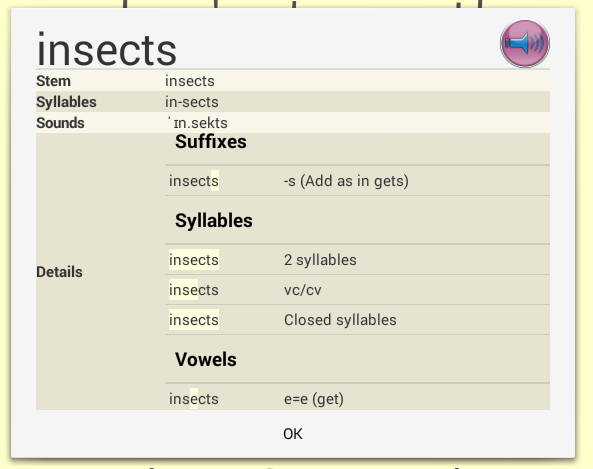
Figure 1 Word structure information
This interface popped up on tap and hold on the tablet reader. During the evaluation, many users commented positively on the usefulness of the feature. For teachers, it provides information about the word not available in standard dictionaries.
2. Annotation rules to highlight chosen phonic features in all words in the text. See Figure 2 and Figure 3 for an example of implementation.
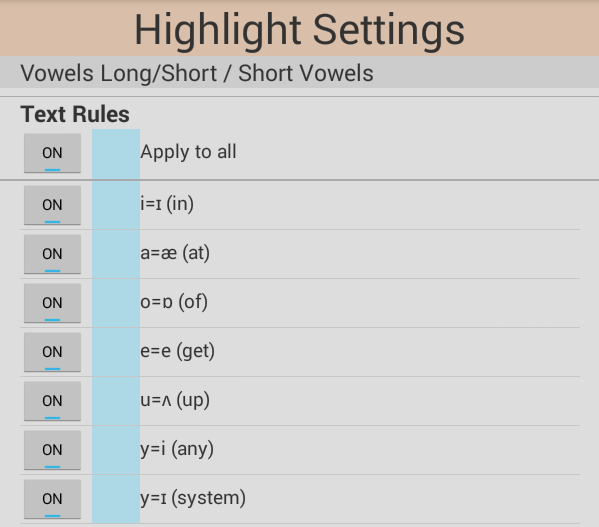 Figure 2 Phonics highlight settings
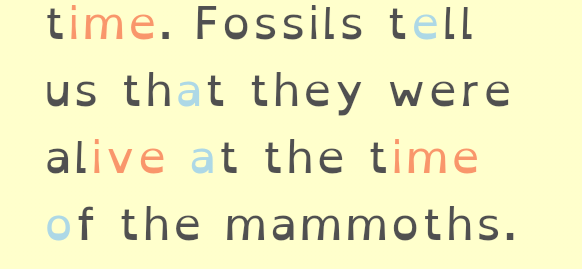 Figure 3 Example of highlighted text (red: long vowels, blue: short vowels)
In order to provide a sensible interface for teachers to choose from 413 phonic features in the profile, pre-sets of typical contrasts were developed to cover areas such as long/short vowels, different pronunciations of vowel letters (e.g. ‘a’ as in ‘made’ and ‘mad’), different pronunciations of consonant letters (e.g. soft/hard ‘c’), different prefix/suffix types (e.g. –ing DOUBLE as in ‘running’ vs ADD as in ‘keeping’).
This sort of functionality is not available in any other automated tool relying on traditional machine readable dictionaries. It was highly appreciated by the teachers we surveyed although it was not possible to evaluate it with readers due to time constraints during the evaluation.
Serious Games Support
Using the text look up routines, a sorted list of words was generated for each entry in the phonics profile. These word lists were then fed into a serious game which utilised the user model to present words associated with a given entry to the player.
The game then used the dictionary annotations to derive the word structure as it was presented to the player in the game depending on the features practiced (e.g. splitting prefixes from words as in Figure 4). The user model and phonics engine were online services which the game can query every time it presents a new activity.
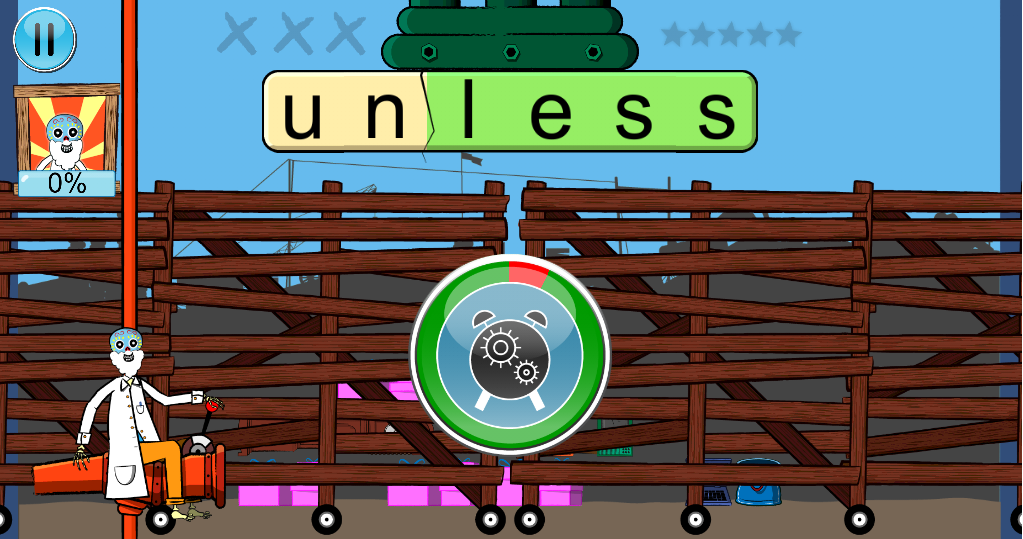 Figure 4 Game utilizing information about word structure
A further layer of clusters was added to the phonics profile to suggest to the game the order in which entries should be practised and which entries can be practised together.
This enabled the game to transcend the limitation of a preset word list and present the readers with more age appropriate words. This builds on the work reported in [2] and opens up the possibilities of the type of phonics learning activities that can automatically process any given word.
Text Classification Tool
This tool takes as input a user profile and a list of plain texts. Then, it calculates the difficulty for each of the texts with respect to the user's difficulties described in her/his user model. Based on the final scores the user can select which of these text has the most appropriate content for her/him. See [11].
Online Text Analysis Service
We are currently completing an online service where teachers can submit their own text for analysis. See Figure 5 for an early mockup of the phonics selection interface.
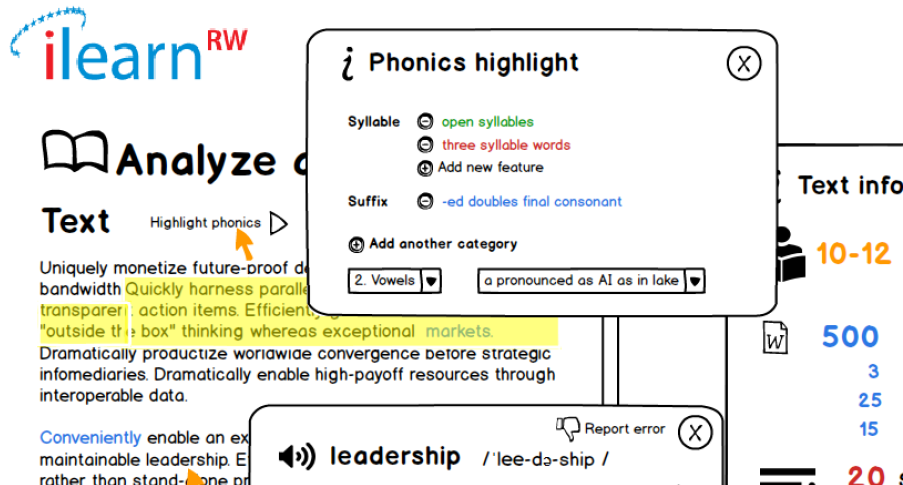 Figure 5 Mockup of an online text analysis service for teachers
One of the features available is a heatmap of phonic features present in a particular text. When present, this can be related to the profile associated with an individual user.
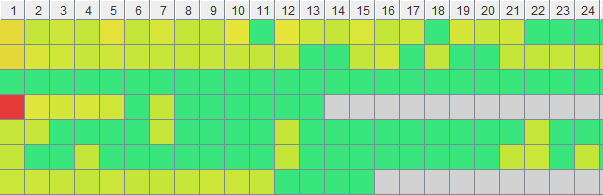 Figure 6 Text phonics heatmap
Conclusions and future steps
We have shown that automated phonics and orthographic guidance is possible and beneficial. Early reactions of teachers who saw the demonstrations have been extremely encouraging. Students also appreciated the results through games and reader feedback, although for them, their exposure to the system was implicit.
This work has revealed a significant gap in the NLP field related to phonics and automated literacy support and we hope that more work in this area will be forthcoming.
The work on the project has generated a number of insights and important lessons. While the approach we took solved the key issues we set out to address, our work also uncovered many new issues that will need addressing. These include the structure of the phonics profile and the balance of individual annotations in the dictionary.
These are the key areas of further development and refinement we have identified based on the present work.
-
Refine the phonics profile of English. In particular, conduct a frequency analysis of individual patterns and reflect issues of difficulty and time of exposure. This will be made possible by the new tools developed as part of this project.
-
Longer English dictionary is necessary. We are currently working on a dictionary based on the MRC Psycholinguistic Database [12] to address the gap.
-
More annotations about word structure and parts of speech need to be added to the phonics dictionary both for English and Greek.
-
Semantic information should be integrated into the guidance, most importantly as it relates to semantic relationships such as synonyms or hyponyms as opposed to dictionary definitions which are often more complex than the word they try to explain. We suggest investigating integration of information from WordNet or FrameNet.
-
While the current dictionary contains some frequency information, this is based on a general purpose corpus of American English. Words should be annotated not only with raw overall frequencies but also with frequencies related to particular genres as well as those derived from a corpus of texts, students are likely to have been exposed to in certain contexts and by certain age. Here we can build on the work of the Children’s Printed Word database [13].
-
Integrate more NLP features into the engine both to identify phonically relevant features such as parts of speech but also semantic information such as sentiment analysis and named entity extraction to increase the accessibility of texts through exposing their structure.
-
Conduct further research into readability metrics with respect to reading difficulties such as dyslexia and evaluate the benefits of personalised text classification.
We are currently in the process of formulating further projects to take this effort forward but we hope to have inspired others to advance our work further. We are working on making the work done so far available to the research community under an open licence.
Acknowledgments
This work has been supported by the EU FP7 ICT project iLearnRW - Integrated Intelligent Learning Environment for Reading and Writing (318803).
Other members of the iLearnRW team contributed to this project. Daniel Gooch developed the first version of the Profile. Johan Andersson of Dolphin Computer Access developed the first version of the dictionary and look up routines.
References
[1] H. A. E. Mesmer, Tools for matching readers to texts: research-based practices. New York: Guilford Press, 2008.
[2] L. Rello, C. Bayarri, and A. Gorriz, “What is Wrong with This Word? Dyseggxia: A Game for Children with Dyslexia,” in Proceedings of the 14th International ACM SIGACCESS Conference on Computers and Accessibility, New York, NY, USA, 2012, pp. 219–220.
[3] J. Rose, “Identifying and teaching children and young people with dyslexia and literacy difficulties: an independent report,” 2009.
[4] G. Brooks, “What works for children and young people with literacy difficulties?,” The Dyslexia-SpLD Trust, 2013.
[5] D. J. Culpeper, P. F. Katamba, P. P. Kerswill, P. R. Wodak, and P. T. McEnery, Eds., The English Language: Description, variation and context. Palgrave Macmillan, 2009.
[6] J. C. Wells, Longman pronunciation dictionary. Pearson Education India, 2008.
[7] D. Jones, P. Roach, J. Setter, and J. Esling, Cambridge English pronouncing dictionary. Cambridge University Press, 2011.
[8] D. Gooch, M. Vasalou, D. Lukes, J. Flower, and L. Benton, “User modelling for users with dyslexia and dysorthographia,” iLearnRW Deliverable 4.1.
[9] C. Walls and R. Breidenbach, Spring in action (3rd Edition). Greenwich [Conn.]: Manning, 2011.
[10] D. Lukes, “Dyslexia Friendly Reader: Prototype, Designs, and Exploratory Study,” presented at the IISA 2015.
[11] C. Litsas, M. Mastropavlou, and A. Symvonis, “Text classification for children with dyslexia employing user modelling techniques,” in The 5th International Conference on Information, Intelligence, Systems and Applications, IISA 2014, 2014, pp. 1–6.
[12] M. Wilson, “MRC Psycholinguistic Database: Machine-usable dictionary, version 2.00,” Behav. Res. Methods Instrum. Comput., vol. 20, no. 1, pp. 6–10, 1988.
[13] J. Masterson, M. Stuart, M. Dixon, and S. Lovejoy, “Children’s printed word database: Continuities and changes over time in children’s early reading vocabulary,” Br. J. Psychol., vol. 101, no. 2, pp. 221–242, 2010.